


Great Collaboration Starts with a Real Problem, Not a Project
The sixth Adapter Club brought together researchers and entrepreneurs in Tartu to explore a highly practical question: What distinguishes a good idea from a successful collaboration? More specifically, how can universities and businesses build partnerships that truly work in the health and food sectors, where innovation moves quickly and new solutions have a direct impact on people’s quality of life as well as companies’ future growth?
The discussion highlighted one key message: successful collaboration starts with a real problem, not with a project.
A Real Business Challenge Drives Innovation
Ragnar Loova, CEO of Nõo Lihatööstus, offered an honest perspective on the realities facing the meat industry, where companies operate under intense competition and constant pressure from rising input costs. Continuous product development and collaboration with research institutions have become an integral part of the company’s strategy.
Loova explained that the company’s work on applying artificial intelligence emerged from a practical need: maintaining product quality while remaining competitive in a demanding market.
Not Every Experiment Needs to Become a Product
Kristi Lehtis, CEO of Chocolala, shared the perspective of a small business and described the company’s collaboration with the University of Tartu to develop ME-3 chocolate. Although the product never reached the market, the goal was to create a chocolate that could help lower cholesterol.
Her experience illustrates an important lesson: not every research project has to result in a commercial success. The collaboration – and the funding that supported it – gave the company the opportunity to experiment, learn, and take calculated risks, even when the final outcome differed from the original plan.
The story of Chocolala’s ME-3 chocolate, together with the company’s subsequent development projects, demonstrated that the true value of innovation lies not only in successful products but also in the knowledge gained through experimentation and the opportunities it creates for future developments.
Shared Goals and Mutual Trust Are Essential
Liis Lutter, Researcher and Head of Product Development at BioCC, introduced a collaborative project with Revala OÜ that resulted in a probiotic-enriched ice cream powder.
According to Lutter, successful collaboration requires more than technical expertise. It begins with a genuine problem to solve, a shared objective, mutual trust, and a willingness to develop solutions together. Research projects should not become goals in themselves – they should provide an opportunity to experiment, learn, and reduce the risks associated with innovation.
Collaboration Gives Research Practical Impact
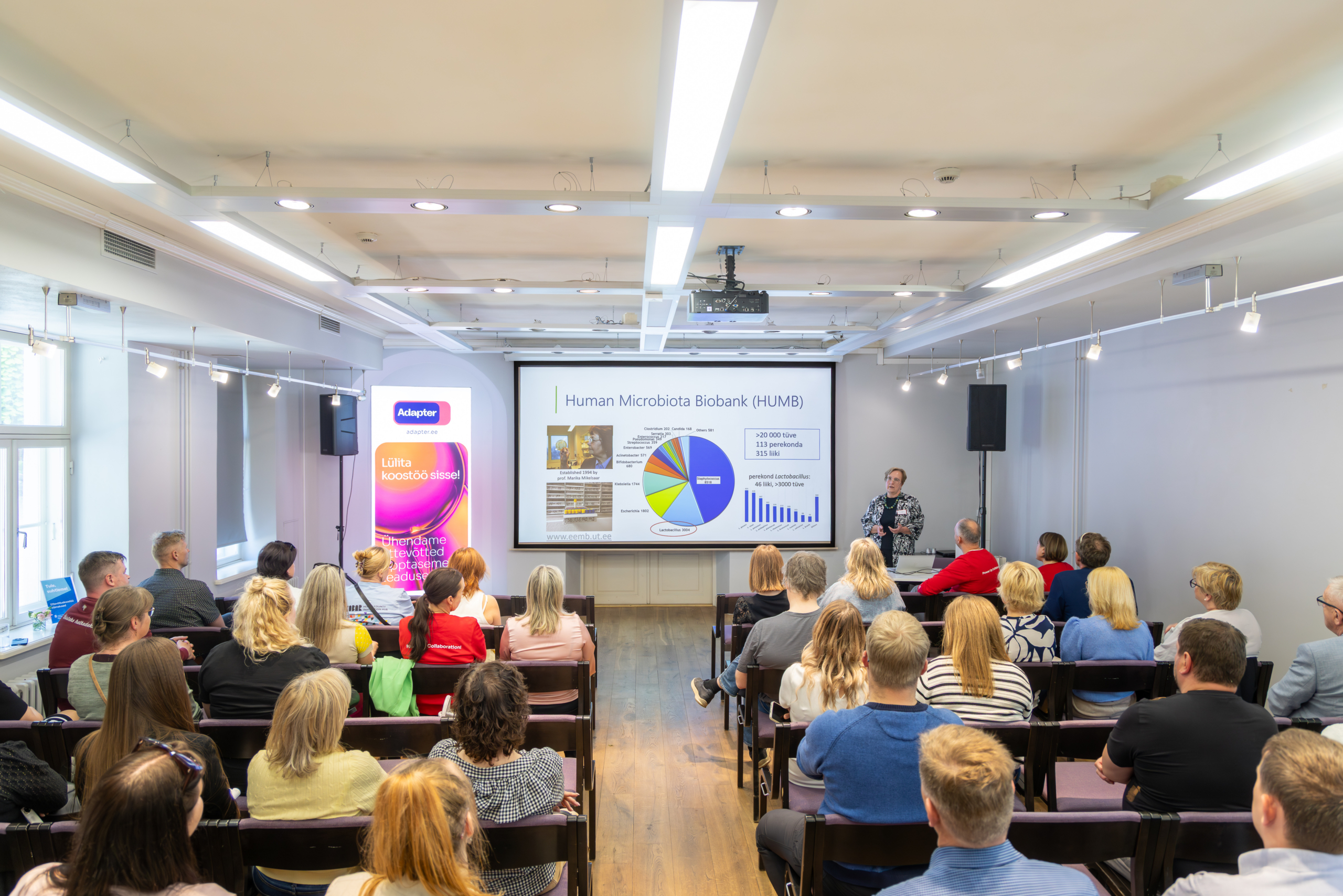
The researchers’ perspective was presented by Professor Reet Mändar, Head of the Department of Microbiology at the Institute of Biomedicine and Translational Medicine, University of Tartu.
She described the University of Tartu microbiologists’ long-standing experience of working with industry, highlighting one of Estonia’s best-known examples of successful research commercialisation: the discovery of the probiotic lactic acid bacterium ME-3, which has since been incorporated into products by numerous Estonian companies.
Professor Mändar emphasised that collaboration with businesses also benefits researchers. It provides opportunities to apply scientific discoveries in practice, generates new research questions, and ultimately contributes to improving people’s health.
At the same time, she stressed that successful partnerships require both researchers and companies to understand each other’s expectations, priorities, and ways of working.
The speakers’ experiences all reinforced the same conclusion: successful collaboration does not happen by chance. It requires a clear purpose, mutual trust, and a genuine commitment from both sides.