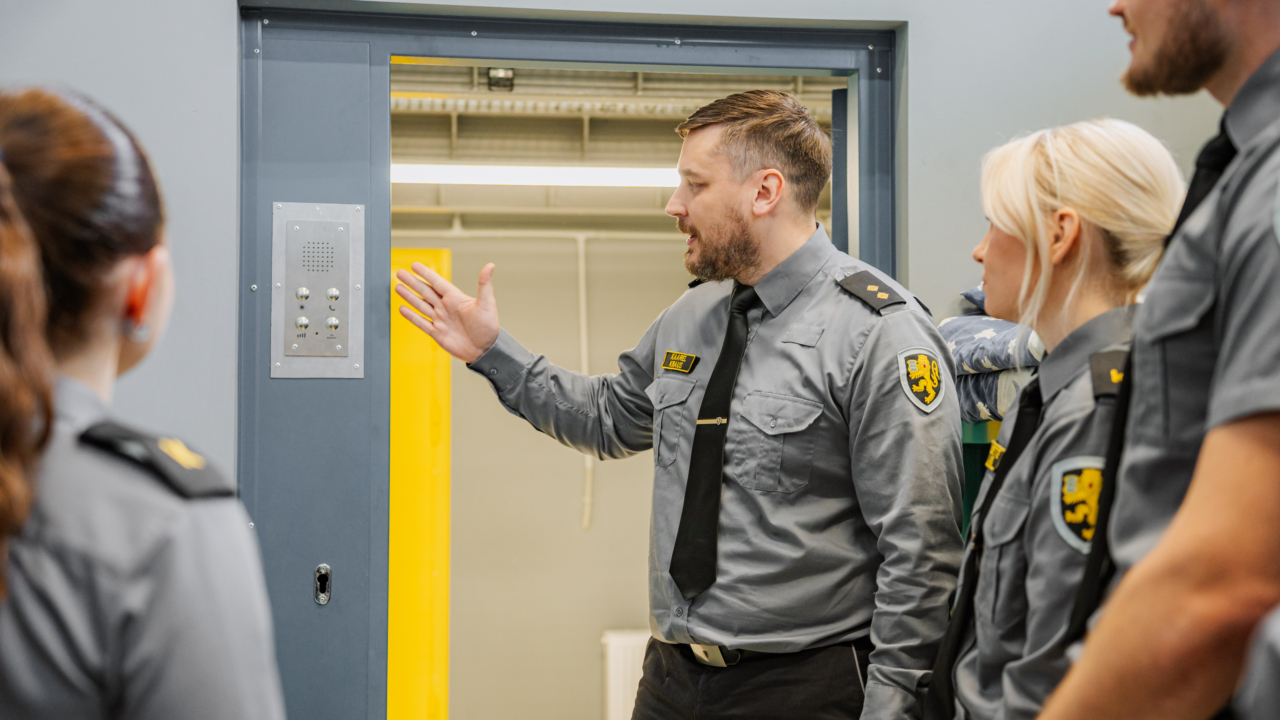
When job responsibilities change, employees’ language needs may change too. Cooperation between the Language Centre of the Estonian Academy of Security Sciences and Tartu Prison shows how sector expertise can help assess employees’ language proficiency and then provide language training tailored to their work.
In early 2026, Tartu Prison began preparing to receive prisoners from Sweden. This created a need to assess staff members’ English proficiency and identify any additional language training they might require.
To find a solution, the prison contacted the Academy’s Language Centre directly. The centre has extensive experience in teaching specialist language skills in the internal security sector.
From language assessment to practical training
As a first step, lecturers at the Academy’s Language Centre developed English tests at different levels of difficulty for Tartu Prison staff and carried out a language proficiency assessment.
The assessment was followed by specialist language training, which continues today. An Academy lecturer regularly teaches Tartu Prison staff the English they need for their work.
According to Tiina Meos, a lecturer at the Academy’s Language Centre, a key advantage of sector specific language training is the opportunity to link language development to learners’ actual job responsibilities.
“Compared with many language training providers, we have extensive teaching experience specifically in the internal security sector. We understand the language used in this field and work closely with sector specialists,” Meos explains.
Sector expertise enables training tailored to learners’ needs
The Language Centre’s strength lies in its knowledge of the internal security sector. General language proficiency is not always enough for staff in the prison service, police and other internal security agencies. Workplace communication also requires an understanding of specialist terminology and situations encountered on the job.
“We adapt our language courses to the learners’ profiles. It is a tailor-made approach,” Meos says.
In addition to teaching specialist Estonian, English and Russian, the centre provides bespoke training for organisations, develops terminology for the internal security sector and supports the design of learning pathways based on learners’ needs. Its expertise also includes instructional design and language coaching. Internal security terminology is available, among other resources, in the Sõnaveeb terminology database.
Specialist language skills create opportunities for cooperation
The Tartu prison example highlights the need for language training that takes an organisation’s working practices and professional requirements into account. For the Academy’s Language Centre, providing such solutions relies on both extensive teaching experience and cooperation with internal security experts.
In Meos’s view, knowledge of the sector is an important asset that is not always given enough consideration when commissioning language training. Although there are many general language training providers on the market, far fewer teachers understand the work processes and terminology of the internal security sector.
The Academy’s Language Centre sees opportunities for closer cooperation with internal security agencies by offering language proficiency assessments, bespoke specialist language courses and language learning solutions tailored to learners’ needs.