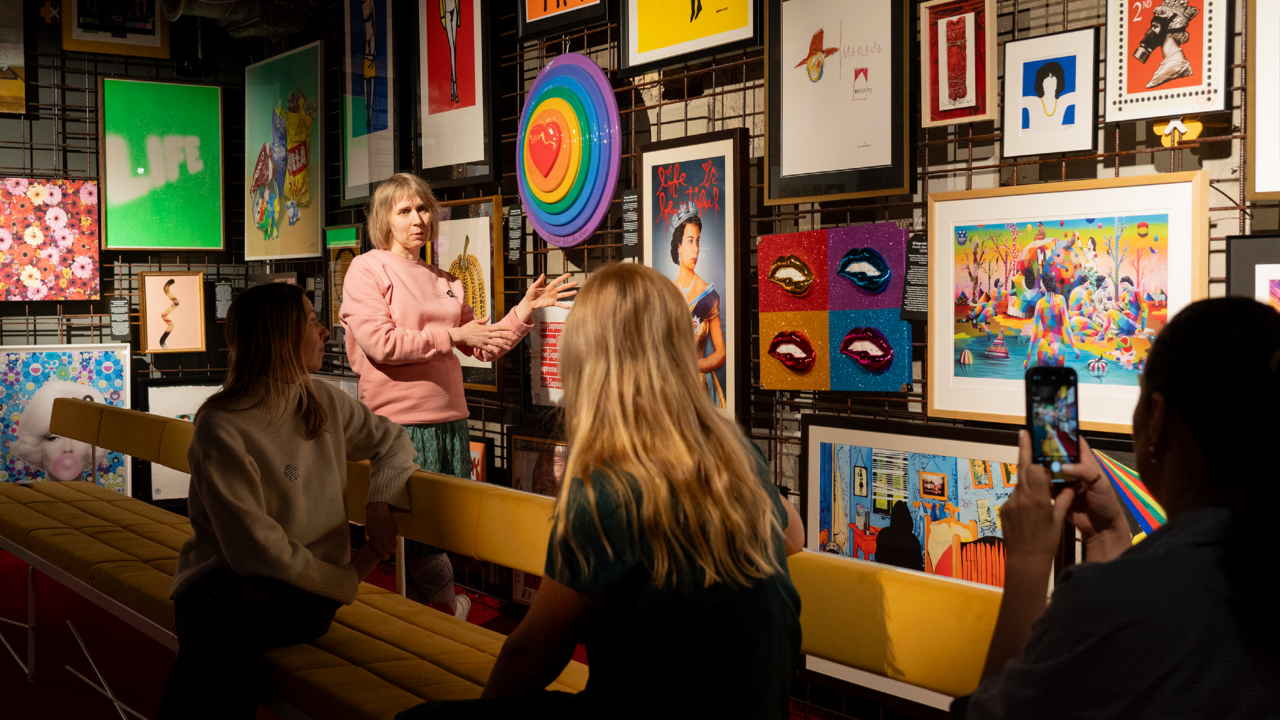
People move through museums in different ways. Some prefer to focus on a single artwork, while others want an overview of the entire exhibition. One visitor may be interested in an artist’s life, another in the historical period or social context in which a work was created. The same exhibition can offer very different experiences to different people.
It was this understanding of visitors’ diverse interests and expectations that inspired the development of a personalised audio guide at the PoCo Museum of Pop and Contemporary Art.
Rather than introducing technology for its own sake, PoCo wanted to help visitors engage more deeply with art. Visitors were already using their smartphones to access information about the artworks by scanning QR codes in the museum’s dimly lit exhibition spaces. This observation sparked the idea of an audio guide—but not a conventional one. The goal was to create a personalised guide that would adapt to each visitor’s interests and preferences. If smartphones were already part of the museum experience, the challenge became finding a way to use them that enhanced rather than distracted from the encounter with art.
According to Birgit Podelsky, PoCo’s Head of Communications and Partnerships, the idea of introducing an audio guide had been discussed for some time. Since visitors were already relying on their phones to access exhibition information, exploring an audio-based solution felt like the natural next step.
The solution was developed in collaboration with Vera Moraa Nyagaka and Ian Waruingi Karanja, students in Tallinn University’s Digital Explorers programme. Together, they created an audio guide that allows visitors to use their own smartphones and headphones to choose content based on their interests, preferred themes, and the amount of time they have available for their visit.
Every Successful Collaboration Starts with the Right Question
PoCo’s experience demonstrates that a well-defined question can be just as valuable as the final solution. Podelsky explains that the students brought fresh perspectives to the visitor experience, and that the project involved much more than technical development alone.
“Ian and Vera were incredibly empathetic and curious. We visited other museums together, and they came back with thoughtful observations and suggestions. They were fully engaged throughout the entire process. It was a genuine two-way learning experience, and their fresh perspective was invaluable.”
For the students, the project also evolved into something much broader than a technology assignment.
“The project showed us that people engage with culture in very different ways. The value of technology is not simply in providing information, but in helping people build a more personal and meaningful connection with what they experience,” says Ian Waruingi Karanja.
Technology Does Not Replace Culture
Culture and technology are often portrayed as opposites – one associated with reflection and contemplation, the other with speed and efficiency. Through the PoCo project, the students came to a different conclusion. Technology does not need to transform the cultural experience; often, its greatest value lies in helping people navigate it more easily or discover new perspectives.
“This project changed how we think about the way people experience culture. We realised that technology can make museum visits more accessible and inclusive, but only when it feels natural and supports the visitor’s experience rather than directing it,” Karanja explains.
For PoCo, this means giving visitors the freedom to choose their own path through an exhibition. Some may wish to explore a single theme in depth, others may prefer a concise overview, while some are most interested in hearing stories about the artists. Personalisation is not about adding distractions – it is about enabling every visitor to find the perspective that resonates most with them.
Why Should Companies Collaborate with Universities?
PoCo’s experience is about more than the development of an audio guide. It also illustrates why businesses and organisations can benefit from partnering with universities.
Universities bring together multidisciplinary expertise, international perspectives, and people trained to ask new questions. Companies contribute practical experience, industry knowledge, and a deep understanding of real-world challenges. When these strengths come together, the result is often far more valuable than a single project outcome.
The students believe that the greatest strength of such collaborations lies precisely in the meeting of different perspectives.
“Students contribute fresh ideas and creativity, while companies bring practical experience and sector-specific expertise. The most valuable solutions emerge when these strengths are combined,” they explain.
Supporting Cultural Experiences Through Technology
The story of PoCo’s audio guide also raises a broader question: what do people seek when they engage with culture?
If the goal were simply to obtain information, viewing artworks online would often be sufficient. Yet people continue to visit museums, concerts, and theatres because these experiences offer something that cannot be replicated on a screen.
According to Birgit Podelsky, museums create space for observations and conversations that everyday life rarely allows. Sharing an exhibition with others can spark discussions that might never otherwise take place. Museums also encourage visitors to slow down. Taking time to stand before a work of art and interpret it personally requires a different kind of attention than the rapid consumption of digital content.
For cultural institutions, attracting new audiences remains an ongoing challenge. Technology can serve as a bridge, helping younger generations discover museums and realise that cultural experiences offer something unique. Technology can make culture more accessible, but meaning itself does not come from technology. It emerges through curiosity, reflection, interpretation, and sometimes the willingness to reconsider one’s own assumptions.
What began as an initiative to improve the visitor experience ultimately led to something much broader: new insights into the people for whom these solutions are created.
Developing the audio guide required far more than technical implementation. It demanded an understanding of how people move through museums, how they engage with culture, and how they make choices during their visit. It is precisely at this intersection that the practical challenges faced by organisations and the knowledge generated at universities come together most naturally.
Student projects represent just one form of collaboration between universities and industry. Universities’ research expertise and applied research capabilities help organisations address complex challenges that often cannot be solved from within the organisation alone.